Simulation and Claude
MGMT 648 · Session 8
Thu Oct 15, 2026
Simulation
A new product, unknown gross margin and volume, positively correlated.
The product
A new product is going out next year. Reception is unknown.
| Low | Most likely | High | |
|---|---|---|---|
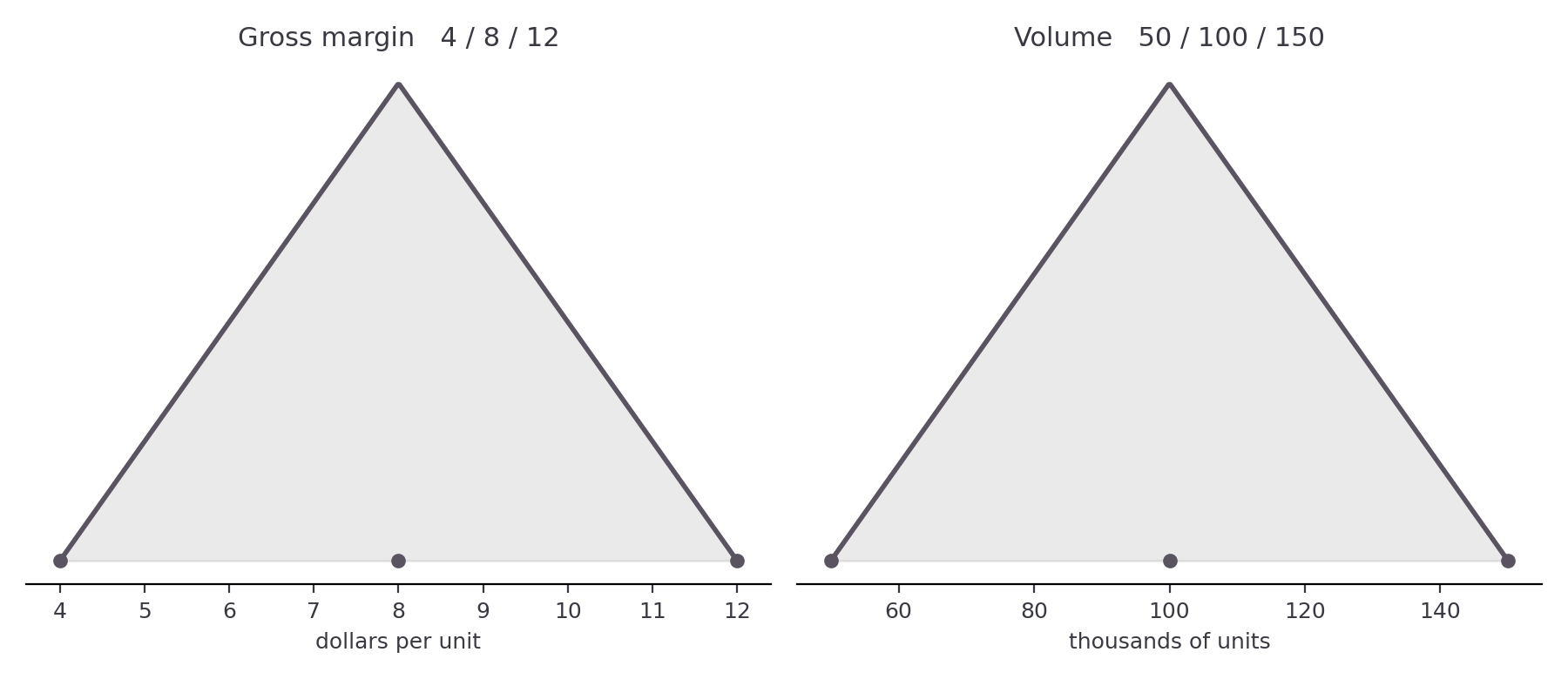
| Gross margin, dollars per unit | 4 | 8 | 12 |
| Volume, thousands of units | 50 | 100 | 150 |
Gross profit is \(\text{gross margin} \times \text{volume}\).
The triangular distributions
Random number generation
Uniform draws
A generator produces a sequence of numbers between 0 and 1 that pass statistical tests for being independent and uniform. The sequence is computed from a starting number, the seed. The same seed gives the same draws.
Any other distribution
Read a uniform draw as a percentile. A draw of 0.30 becomes the 30th percentile of the margin tent. Repeated many times, the results follow the tent.
Try it
Prompt
Generate 1,000 random numbers from a tent distribution with a lower bound of 4, a peak at 14, and an upper bound of 24, and plot the histogram.
Gaussian copula
Two uniform draws can be used to generate two correlated standard normals. We can use those to create variables with other distributions that move together.
- Draw two standard normals with correlation \(\rho\).
- Convert each to a percentile of the standard normal distribution..
- Convert the first percentile to a margin and the second to a volume, each through its own tent.
One thousand draws at three correlations
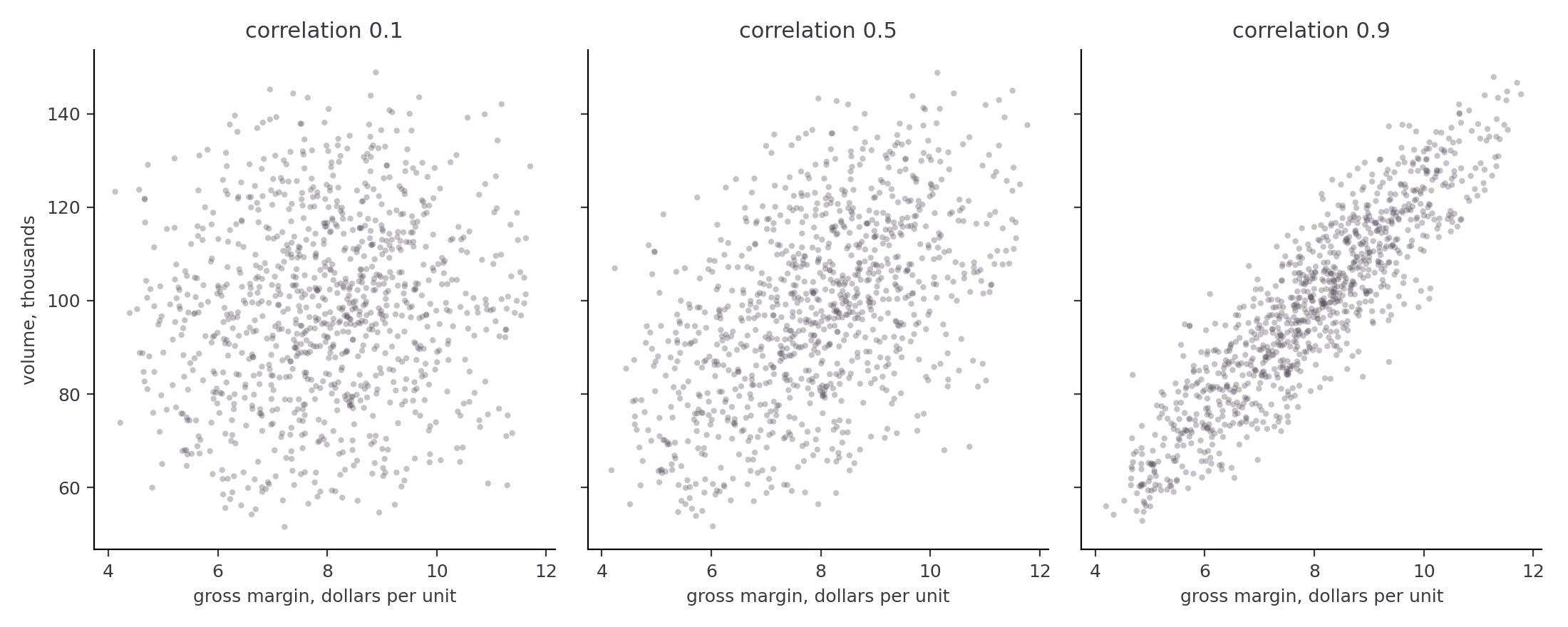
Margin and volume through a Gaussian copula
The prompt
Prompt
Gross margin is triangular on 4 / 8 / 12 dollars per unit, volume triangular on 50 / 100 / 150 thousand units, correlated 0.6 through a Gaussian copula. Gross profit is margin times volume. Draw 100,000 times, plot the distribution of gross profit, and report the mean.
One hundred thousand draws
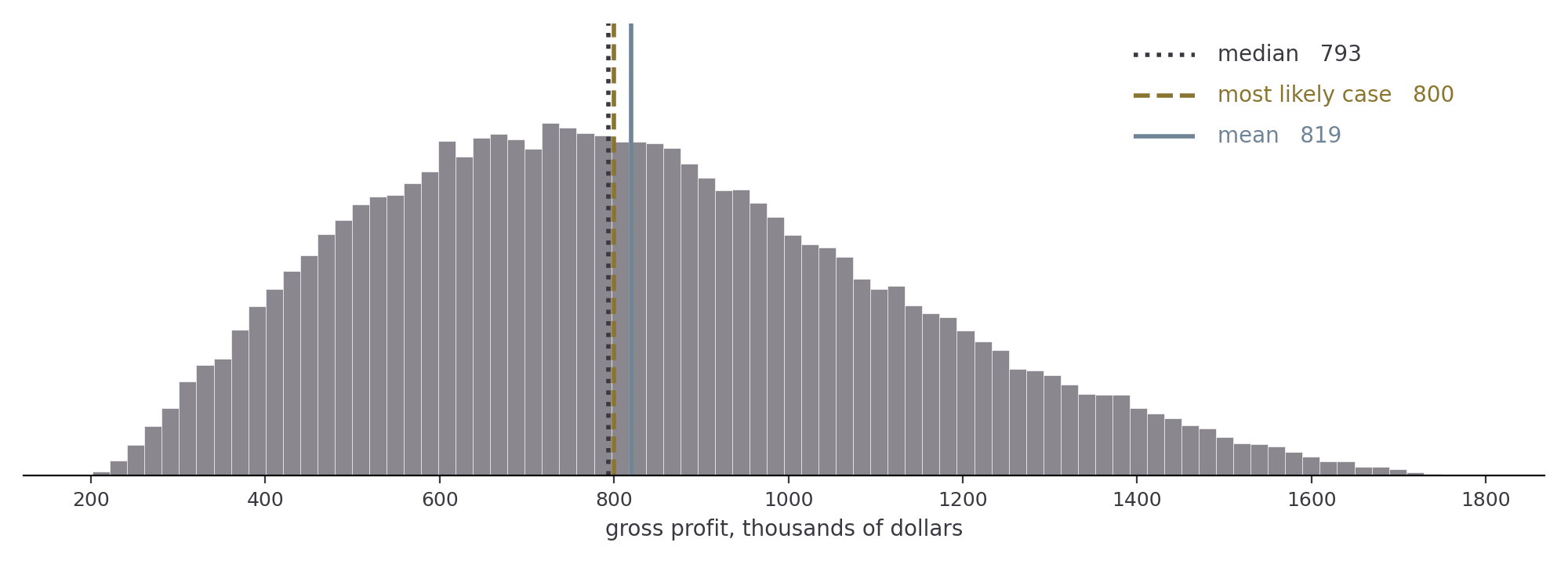
Margin and volume drawn together at correlation 0.6
Another example: a loan portfolio
A bank holds 100 loans of $1 million each. Each defaults with probability 3 percent, and a default loses the full $1 million.
Linking the defaults
Each loan gets a standard normal draw, and every pair of draws has the same correlation. A loan defaults when its draw falls below its 3rd percentile.
Three cases
Correlation 0, 0.2, and 0.5. Each loan defaults 3 percent of the time in every case.
The prompt
Prompt
A bank holds 100 loans of $1 million each, each defaulting with probability 3 percent and losing the full amount. Link the defaults through a Gaussian copula with the same correlation for every pair. For correlations 0, 0.2, and 0.5, draw 100,000 times and report the mean loss, the median, the 99th percentile, and the share of draws with no default. Plot the three loss distributions side by side.
Claude
Versions, customization, Claude on your phone, and artifacts.
Things to know
Versions
Claude.ai, Claude Desktop, and the Claude Code CLI.
Projects
Instructions and files shared by every chat in the project.
Customize
Connectors, skills, and plugins.
Claude on your phone
Start or continue conversations in the phone app.
Cloud tasks
Long tasks keep running after you close the laptop.
Models and limits
Which model answers, and how much use the plan allows.
Data settings
Training on your chats, and what Claude can see.
Artifacts
Pages Claude builds and publishes at a link.
Versions
| Where it runs | What it can reach | |
|---|---|---|
| Claude.ai | Browser, phone | Uploaded files, connectors, cloud tasks |
| Claude Desktop | Mac or Windows app | A folder on your computer |
| Claude Code CLI | Terminal | Your files, software, and terminal |
Chat and Cowork are now one conversation on Pro and Max. Claude decides whether a request needs a quick answer or a multi-step task. Desktop keeps a separate Code tab.
Projects
A workspace for one piece of work: a course, a client, a case.
- Instructions: apply to every chat in the project
- Knowledge: files every chat can draw on; large collections are searched rather than read in full
- Chats do not see each other; anything shared goes in the knowledge
Files in project knowledge are cached, so reusing them in later chats counts less against usage limits than uploading them again.
Customize
Connectors
MCP servers that give Claude tools for an outside service: data, email, calendar, files. Settings → Connectors.
Skills
A folder of instructions, and optionally scripts, that Claude loads when a task matches the skill’s description.
Plugins
A bundle of skills, connectors, and commands, installed together from a marketplace.
Claude on your phone
- Claude conversations, other than Claude Code, can be started or continued in the Claude phone app
- Claude Code conversations can also be continued in the phone app: type
/remote-controlin the conversation on your computer, and it appears in the app
A Claude Code conversation keeps running on your computer, so files, tools, and connectors stay there. The computer has to stay on and Claude Desktop has to stay open.
Cloud tasks
- More involved tasks run in the cloud and keep going after you close the laptop or the page
- Since October 6, new tasks on Pro and Max run in the cloud by default
- Scheduled tasks can run in the cloud while your computer is off
- A task that uses files or apps on your computer needs Claude Desktop open
Models and limits
| Model picker | Fable, Opus, Sonnet, Haiku: larger is more capable and uses more of your allowance |
| Session limit | Resets every five hours |
| Weekly limit | Shared across Claude and Claude Code |
| Past the limit | Usage credits at API rates, with an optional monthly cap |
Current use is under Settings → Usage.
Data settings
- Free, Pro, and Max: a setting controls whether your chats and Claude Code sessions are used to train future models
- Turning it off applies to new chats; data already used in training stays there
- Team, Enterprise, and Education plans are governed by the organization’s agreement
- Claude sees what you connect: uploaded files, connectors, trusted folders
Settings → Privacy. Give Claude a dedicated working folder rather than your whole drive.
Artifacts
A web page Claude writes and publishes on claude.ai: a report, a dashboard, a calculator, a small app.
- Private by default; you choose whom to share the link with
- Updating it keeps the same URL
- Can store data that viewers enter, and can ask Claude questions from the page
Try it
Click Artifacts. Upload the Brannock Chemicals case PDF. Then:
Prompt
Build an artifact showing the DCF for the Brannock Chemicals resin plant. Put sliders for price, volume, variable cost, and cost of capital at the top, with NPV and IRR beside them. Below, show the year-by-year DCF table and a chart of annual cash flows.
Check that the base case gives an NPV of $65.1 million.
MGMT 648